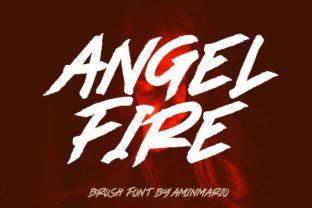
Angel Fire Font Review
There I was, staring at a blank brand board, trying to find the right tone for a boutique skincare line that wanted to feel both elegant and approachable. I’d tried a few serif fonts, but they felt too rigid, too traditional. Then I stumbled on Angel Fire. It’s one of those rare fonts that feels like it was made for this exact moment—soft, expressive, and full of character.
Angel Fire for Boutique Branding and Handmade Shop Identity
Angel Fire is a Script Handwritten font that feels like it was drawn with a brush pen and pencil in one go. The strokes are smooth, the curves are gentle, and there’s a warmth to it that makes it feel authentic. It’s not overly ornate, but it has enough personality to stand out without being overwhelming. In a boutique branding project, it worked perfectly as a logo font, adding a personal touch to a brand that needed to feel human and trustworthy.
When I tested it on a business card mockup, it brought a sense of craftsmanship to the design. The font paired well with a simple sans serif for body text, creating a clean contrast that kept the overall look professional yet inviting. It’s ideal for handmade shops, artisanal brands, or any small business looking to convey a sense of care and individuality through typography.
Angel Fire for Packaging Design and Product Labels
One of the most rewarding moments was seeing Angel Fire on a product label for a custom candle brand. The font added a softness that matched the product’s calming vibe. It looked great in both large and small sizes, though I found that it works best when used sparingly. Too much of it on a package could feel cluttered, especially if the design already had a lot going on.
In packaging design, Angel Fire is best used as an accent or headline font. It adds visual interest without overpowering the rest of the design. For a bakery or café, it could be perfect for a tagline or signature element. The font’s handwritten quality gives it a tactile feel, making it ideal for products that rely on emotional storytelling.
Angel Fire for Web Design and Social Media Graphics
I also tested Angel Fire on a website header and social media layout. On a homepage hero section, it caught the eye immediately. It added a sense of movement and energy that a more static font wouldn’t have provided. For social media posts, especially for a lifestyle or wellness brand, it felt natural and engaging.
One thing to note is that Angel Fire doesn’t work as well in long paragraphs. It’s not a font you’d want to use for body copy, but as a display font, it shines. When paired with a modern sans serif, it creates a balanced look that feels both contemporary and personal. This makes it a great choice for web design elements like headings, banners, or call-to-action buttons.
Angel Fire for Logo Design and Brand Identity Systems
As a logo font, Angel Fire has a unique charm. It’s not the kind of font that would work for a high-end corporate brand, but for a creative studio, a local restaurant, or a small-scale entrepreneur, it can be a strong identity driver. It brings a sense of authenticity and creativity that aligns well with indie and craft-oriented brands.
When designing a logo system, I found that Angel Fire pairs well with a minimalist typeface. This helps balance its expressive nature while keeping the overall look cohesive. It’s also worth noting that the font includes multiple alternates and ligatures, which can be useful for fine-tuning the look of a brand’s typography.
Angel Fire for Editorial Design and Print Projects
Finally, I used Angel Fire on a poster and flyer for a local art event. The font added a whimsical touch that complemented the creative theme of the event. It worked well in a larger size, where its details could be appreciated without becoming hard to read.
For print projects, it’s important to test the font at different sizes and on different paper stocks. While it looks great on a glossy brochure, it might lose some of its clarity on a rougher texture. As with any script font, readability is key. Angel Fire is best used in short phrases, such as headlines, captions, or taglines, rather than extended blocks of text.
Before using Angel Fire in client work, I always recommend testing it in different contexts. Try it on a mockup, a business card, or a website prototype to see how it performs. Also, make sure to check the font’s licensing terms, especially if you’re planning to use it in commercial projects or print-on-demand products.